
Clothes that kill

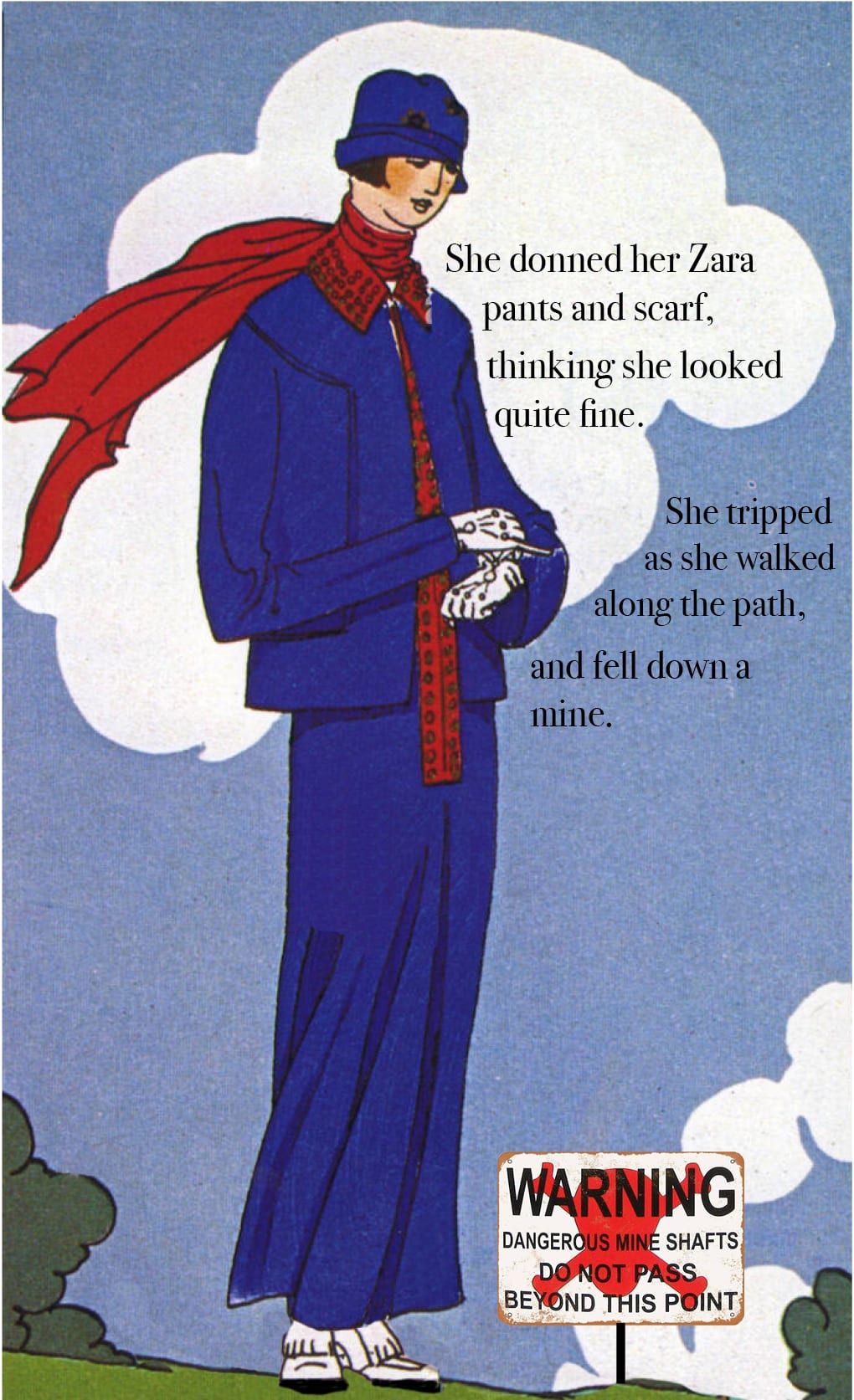
I recently read an article about the new Zara death pants. These are loose and airy wide-legged pants available at the high street clothing chain that have caused serious injury to their wearers, because the excess fabric is a tripping hazard. I’m not sure why these particular pants have been singled out, because maxi-dresses are equally lethal.1 Indeed, the Zara death pants are merely the latest in a long line of clothes that have maimed and occasionally killed their wearer over the centuries.
Probably the most notorious example is long, flowing neck scarves.2 The American dancer and choreographer Isadora Duncan was murdered in 1929 by her red silk shawl after it got caught in the spokes of the convertible she’d just stepped into. She might be the most famous person to have died in this fashion, but hers is far from an isolated case—death-by-scarf is common enough that it’s called Isadora Duncan syndrome and long scarf syndrome in the medical literature.
In addition to scarves, the book Killer Fashion: Poisonous Petticoats, Strangulating Scarves, and Other Deadly Garments Throughout History, details—in verse3—a variety of other lethal clothing items, from historical relics like corsets, fontages and crinolines, to contemporary items like high heels.
Confirming my longstanding belief that high heels should be avoided like the literal plague, they have been responsible for numerous deaths, including that of the British socialite Jennie Jerome Churchill. As Killer Fashion puts it, ‘Old Winston Churchill had a mum who thought that flats were very dumb. Tripped on her heels, fell down the stairs, now no one looks at what she wears.’ Indeed, internet footage abounds of accidents in high heels, some of which look literally back-breaking.
Of course, flip flops are not much better.4 Podiatrists warn of ‘stress fractures, tendonitis, arch pain, and heel pain.’ And if you step behind the wheel of a car in a pair, your chances of an accident increase exponentially, because of their tendency to get caught on pedals and wedged beneath them.
Lest you think it’s primarily women who are attracted to dangerous clothing, let me assure you that men are similarly afflicted. For example, the pointed and starched shirt collars favoured by nineteenth-century dandies were frequently so high that they couldn’t turn their head, and falling asleep in one was potentially fatal—an 1888 issue of the New York Times reports at least one man asphyxiating on his own collar.
Men’s flirtation with clothing seemingly designed with strangulation in mind did not stop at shirt collars.5 Witness the modern necktie, which was born in the 1920s. Beyond the obvious dangers of wearing what amounts to a mini-noose around one’s neck, neckties have been associated with reduced intraocular pressure and cerebral blood flow. Neckties, it appears, worsen your eyesight and make you dumb.
The situation is just as dire below the belt as above the neck. Most of us have seen boys and men in pants so large, low and baggy that they are constantly in danger of tripping or losing their britches—or both. Of course, tight pants entail their own problems. The much touted reduction in sperm count in men can probably be at least partly blamed on tight pants.
It wasn’t always this way. Archaeological theories suggest that the use of clothing evolved to support human evolution rather than hinder it. For example, the archaeologist Ian Gilligan highlights the requirement for portable thermal protection as humans moved beyond the tropics into colder climates during the Pleistocene ice ages. He argues that the social and psychological aspects of clothing—i.e., dress as a symbolic adornment or expression of modesty—were probably secondary elaborations of an item that, initially at least, had a critical biological role in supporting survival.
However, the French philosopher and semiotician6 Roland Barthes argued that we can’t understand the evolution of clothing merely in terms of the passage from protection to ornamentation. In his words,
‘The first Roman soldiers to throw a wool cover over their shoulders so as to protect themselves from the rain were performing an act of pure protection. But once material, form and usage have become not so much embellished, but simply regimented by a defined social group, the garment has joined the system’.
According to Barthes, once clothing has entered a social system, bodily coverings are transformed into dress, and play by certain social rules that have nothing to do with their utilitarian or decorative attributes. Indeed, he argued that to assess bodily coverings in this way entirely misses the point.
Still, anyone watching a haute couture fashion show,7 where ridiculous, bizarre and obscene outfits rule the day, will have cause to suspect that such clothing, for the most part, has long ceased to have any functional purpose. Instead, a lack of wearability seems to be its entire point—as the following selection of photos attest. But less explicable is the fact that much of our clothing seems not just lacking in functionality but engineered to actively maim and kill us.


Consider the bright red British military uniforms of the nineteenth century. Designed to boost troop morale, their colour had the entirely predictable effect of making soldiers extremely easy to pick off in battle.8 As the military historian Tony Fremont observes in Margaret Atwood’s novel The Robber Bride, ‘Many have been the crimes committed on helpless enlisted men by the designers of military clothing. How many British soldiers died needlessly because of the redness of their uniforms?... Murder by designer!’
After the heavy troop losses incurred in the Zulu War, the military wised up in the subsequent Boer wars and adopted khaki, which provided better camouflage in the South African landscape. However, camouflage clothing itself wasn’t developed until the twentieth century. Yet even in a pattern explicitly designed to emulate nature, the biologist Laszlo Talas and his colleagues have found evidence of considerable cultural diversity, with countries adopting their own designs, or changing them to suit new political allegiances (e.g., the ‘NATO style’).
So what does this say about humans as a species? Having given the matter some thought, it’s frankly difficult to read this as anything other than the death instinct at work. First outlined in Sigmund Freud’s Beyond the Pleasure Principle, we have, in his words, ‘been led to distinguish two kinds of instincts: those the purpose of which is to guide life towards death, and the others, the sexual instincts, which perpetually strive for, and bring about, the renewal of life.’ He suggested that our life and death instincts are in constant battle.
According to psychoanalysts, these duelling instincts play out in the realm of fashion.9 The psychoanalyst Patricia Gherovici argues that fashion is a way of ‘making our mortal bodies look a little better’ while ‘dressing up the death drive’. As the curator Valerie Steele observes in the same article, ‘far from being superficial, fashion exposes people’s desires and anxieties like a psychosomatic rash’.
I can think of little better illustration of the tension between the life and death instincts than the ‘No capes!’ scene in The Incredibles. In it, Mr Incredible rhapsodises over his ideal ‘hero’ suit, which involves a cool-looking cape, and the fashion designer Edna Mode immediately lists a litany of superheroes who died as a result of mishaps caused by their capes. ‘Do you remember Thunderhead?’ she asks. ‘All was well. Another day saved when his cape snagged on a missile.’
It’s as if the sexual drive and the death drive often conspire, with the former—especially our desire to look good—actively undermining our instinct towards life. As Killer Fashion observes of corsetry, ‘Corsets were considered a must to cinch the waist and flatter the bust. Victorian women held their breath, and, stylishly, were squeezed to death.’
The moral of the story is that maybe we should pay the same attention to making our clothes death proof that we pay to making our homes child proof. Perhaps it’s time to reconsider the Zara death pants, the low-crotched baggy jeans, and the wisdom of tying strips of dangling fabric around our carotid arteries. Because you might love killer new fashion, but it shouldn’t actually kill you.
Related posts


For instance, you take your life in your own hands if you try to walk down stairs in one.
Notice a theme? Long and flowing clothes might look bohemian and ethereal, but they are basically designed to kill you.
Think Edward Gorey’s The Gashlycrumb Tinies mixed with Horrible Histories. Sample verse: ‘Asbestos cloth could not catch fire, making it seem like fine attire. But no one knew that fibers clung, forever in their poisoned lungs.’
A.k.a. ‘thongs’ if you are Australian—the underwear is exclusively known as a ‘G-string’.* Admittedly, ‘flip flops’ has the benefit of clarity, being simultaneously a name and a warning.
*Although it’s my firm belief that G-strings are even less practical than flip flops. Bach’s ‘Air on the G String’ captures it best—when you wear one you get a lot of unnecessary aeration. (Sorry!) Even more aeration is provided by the crotchless G-strings currently, albeit controversially, being sold at the British department store Marks & Spencer. As far as I can tell, a lack of functionality is the very definition of women’s lingerie.
So strong is the association that neck ties have been described in the medical literature as ‘socially desirable strangulation’.
Semiotics is the study of signs and symbols—think the ‘symbologist’ Robert Langdon in The Da Vinci Code, the difference being that this is a real academic specialty rather than a dumb made up one.
Or the Met Gala, where celebrities strut their stuff in uniformly daft outfits.
Which, one would assume, had a rather dampening effect on said morale.
For the record, I’m not talking about people who kill themselves as a result of sheer idiocy. Take 33-year-old Darren from Leicester, the winner of the 2006 Darwin Award. Darren was found dying from stab wounds to the chest following a call to emergency services. The police initially assumed foul play but it was later determined that Darren had decided to check whether his new jacket was stab-proof by, you guessed it, stabbing himself in it.
I love watching people in over the top clothes. Adds to the joy of people watching.
Interesting! No Zara pants for me... or high heels or God forbid, scarves :-) I like comfy clothes. Thanks for your informative article!